down the tarantula hole...

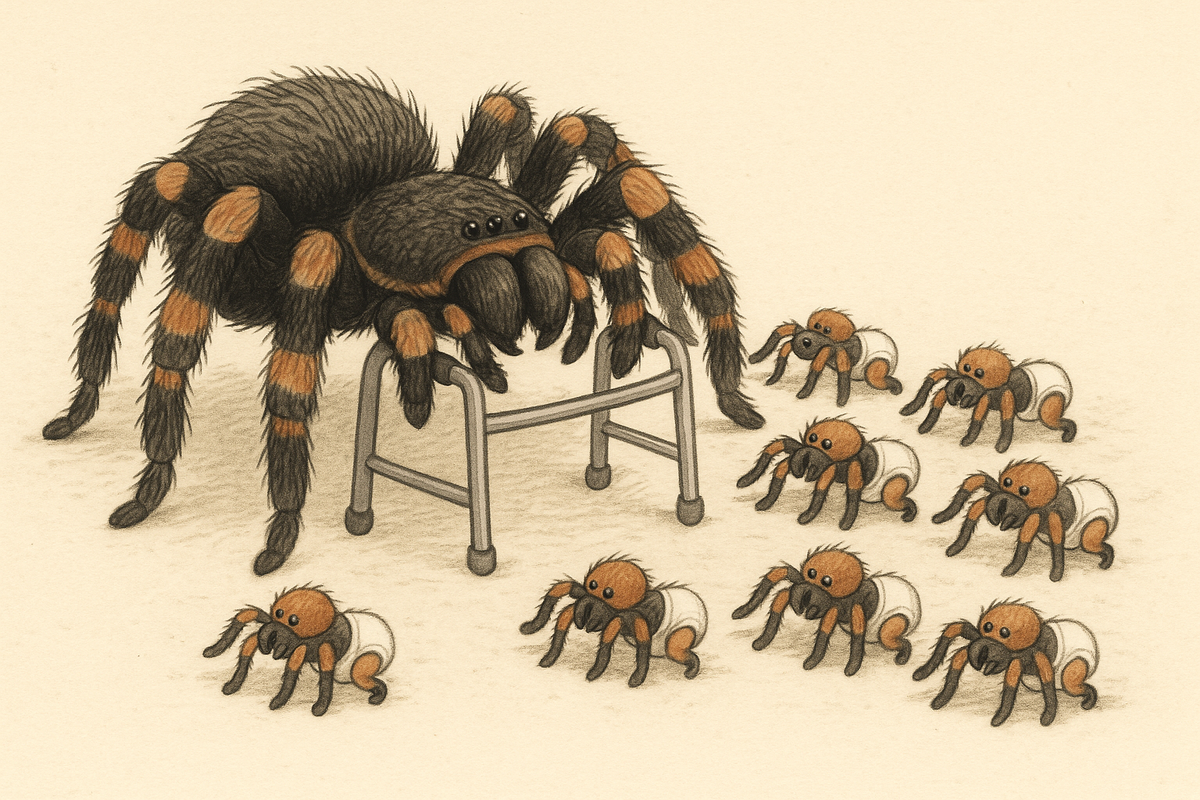
Female tarantulas can live 20–30+ years.
Males make it to maturity… mate… and then die off not long after so you end up with this wild asymmetry:
- One female, alive for decades
- Wave after wave of short-lived males cycling through
And it gets stranger:
Females can store sperm in these little internal vaults (spermathecae) and use it across multiple egg sacs. But it’s not permanent storage. Sperm quality degrades. So they keep remating over their long lives, pulling in new male cohorts every few years.
So evolution isn’t acting on “the tarantula population” in some neat symmetric way.
You get:
- Males as the rapid-iteration R&D department
- Females as the long-term genetic archive
Males evolve fast because their generations turn over fast.
Females evolve slowly because they’re basically time capsules.
Then I started playing out a scenario that broke my brain a little; imagine a drought that lasts as long as a full male lifecycle.
Every male alive during those years? Filtered through brutal drought conditions.
Only the drought-hardy ones get to mate. The male gene pool gets purged and rebuilt in a single sweep.
The females? Some are young and get hammered by selection.
Some are middle-aged veterans who’ve already survived multiple environmental swings. Some are old tanks who are just… still there.
So after the drought you have drought-optimized males mating with females carrying genes tuned to conditions from 10, 15, 20 years ago.
If the environment keeps oscillating (wet/dry/wet/dry), this asymmetric setup is actually kind of genius:
- Males track the present
- Females prevent the species from overfitting to one weird decade
But if climate change pushes things in one direction (drought is the new normal)… that same setup becomes a liability.
Males adapt quickly.
Females adapt slowly.
The females become the evolutionary anchor that might drag the whole system down.
And it gets even darker:
A long-lived female who mated before the drought might still be using “old climate” sperm during the drought. She’s literally time-traveling maladapted genes into the harshest possible environment.
Questions I’d love to actually test:
- Can we detect different evolutionary rates between male-biased and female-biased traits?
- How does sperm storage change the picture when environments flip mid-lifetime?
- Are females genuinely a stabilizing archive… or a long-term bottleneck under rapid climate change?